

Texting Prospective Students
Month: August 2026
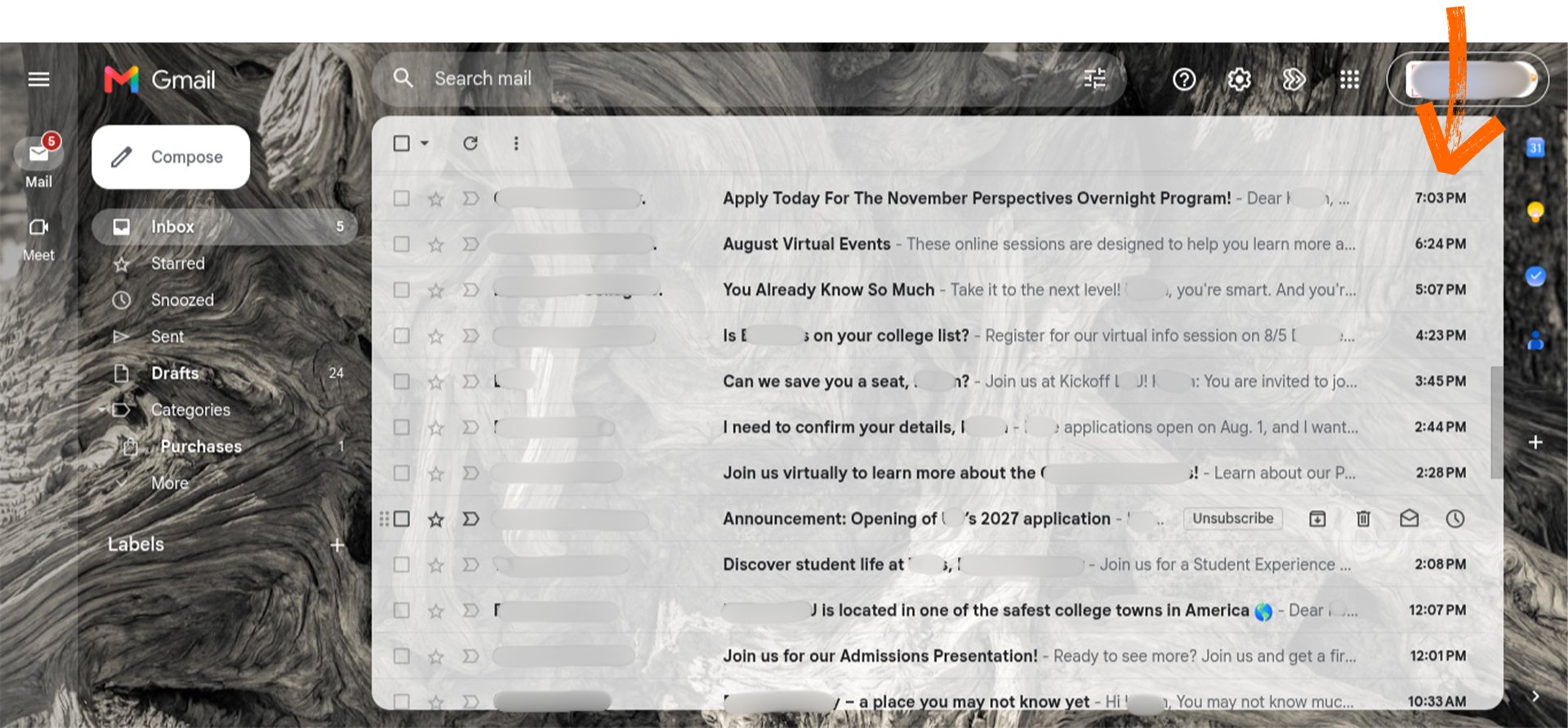
Let’s be honest: Email may be today’s students’ preferred method of contact from colleges and universities, but they certainly aren’t sitting around compulsively checking their inboxes. Even when they do get around to looking at them, it’s easy to understand why they’d do a quick skim before moving on.
Tell me honestly… would you take the time to go through all of this? (And look at those timestamps!)
We also know that they ignore calls from unknown numbers and leave printed mail untouched on the kitchen counter.
But text messages… That’s a different story. They’re immediate, personal, and often seen within minutes.
For admissions teams trying to connect with prospective students in a crowded communication landscape, SMS has evolved from a nice-to-have feature into one of the most powerful engagement tools available. Whether you’re using Slate, Element451, Salesforce, or another CRM, a well-planned texting strategy can help move students from inquiry to enrollment more effectively.
The key, however, isn’t sending more texts — it’s sending the right text at the right moment.
Why Text Messaging Works
Students live on their phones. Text messaging meets them where they’re already spending their time.
When used strategically, SMS can help admissions teams:
- Increase student engagement
- Build affinity
- Deliver time-sensitive information quickly
- Reduce application melt
- Encourage event attendance
- Support students throughout the enrollment journey
But successful texting goes beyond sending deadline reminders. The most effective programs use SMS as part of a larger communication strategy designed to build relationships — not just drive transactions.
SMS vs. MMS: What's the Difference?
Most institutions are familiar with SMS, the traditional text-only message format. But many CRMs also support MMS (Multimedia Messaging Service), which allows admissions offices to send visual content alongside text.
SMS is ideal for:
- Application deadline reminders
- Missing document notifications
- Event confirmations
- Deposit reminders
- Quick calls to action
MMS can elevate engagement with:
- Stunning campus photos
- Personalized welcome messages
- Student testimonial videos
- Open House highlights
- Orientation resources
- GIFs and visual storytelling
Think of SMS as the quick conversation and MMS as the opportunity to bring your institution’s personality to life.
Not every message requires multimedia, but incorporating MMS strategically can help your communications stand out in a sea of notifications.
Personalization Is the Secret Sauce
Nobody wants to receive texts that feel like mass marketing.
Students expect text messages to be more personal than email, and they can quickly recognize when a message feels automated or irrelevant.
Modern CRM platforms make it possible to personalize messages using:
- Student name
- Academic interests
- Geographic location
- Assigned counselor information
- Event participation
- Application status
- Behavioral engagement data
Imagine this scenario:
A student attends your Open House on Saturday. On Monday morning, they receive a text from their admissions counselor:
“Hi Maya! Thanks for joining us this weekend. Do you have any questions about the Nursing program or the application process?”
That feels less like marketing and more like a conversation.
And conversations are what build relationships.
The Best Texts Feel Human
Here’s a simple question every admissions office should ask before sending a text:
Would this feel helpful if I received it?
Students reserve their text inboxes for friends, family, and trusted organizations. If every message sounds promotional, your institution risks becoming background noise.
Some texting best practices include:
- Write like a human
- Use a conversational tone
- Keep messages concise
- Include a clear next step
- Make it easy to respond
- Use recognizable phone numbers
- Respond quickly when students reply
The most successful enrollment teams don’t use texting as a megaphone — they use it as a conversation starter.
Compliance Is Not Optional
Texting is powerful, but it also comes with responsibilities and legal obligations.
Before launching any SMS campaign, institutions must ensure they’re in compliance with applicable regulations and industry guidelines.
These include, but are not limited to:
- Explicit opt-in to receive text messages
- Immediate opt-out (STOP, QUIT, etc.)
- 10DLC compliance
- Sharing that messaging and data rates may apply
It’s also helpful to make sure students understand what types of messages they’ll receive and how frequently they’ll hear from your institution (setting expectations up front is always a good thing!).
Transparency doesn’t just support compliance — it builds trust, which is essential for meaningful student engagement.
Now that you have a better understanding of how to leverage text messaging, it’s time to start building out your strategy! Need a hand? You know the SparkAssist team is always here for you. Connect with us today!


Why Connected TV Belongs in Your Enrollment Marketing Mix
Month: August 2026

by Ann Levy, Director of Digital Marketing
Imagine a prospective student and their family settling in to stream their favorite series. In between episodes, your institution’s brand appears — naturally integrated into the viewing experience.
This is the growing role of Connected TV (CTV) — aka streaming TV ads — creating new opportunities to connect with your prospective students and their biggest influencers beyond the classic enrollment marketing channels. Showcasing your institution on popular streaming apps helps build trust and recognition among families who get to see your logo on the big screen in their homes. As the space evolves, it’s also becoming increasingly accessible, offering more precise targeting and clearer measurement than traditional television — making it not just a newer marketing channel, but also a more accountable one.
If your media plan doesn’t include reaching students and families during their weekly household streaming time, you’re missing out on the most important shift in how families consume media together today. While many of our college partners have already added CTV to their media mix with us, we want to ensure everyone is in the know about this growing trend and opportunity.
The Stats Speak for Themselves
As of this year, a new study estimated that US households with internet access consume more than 43 hours of video content per week! That’s equal to 25% of our week! Another recent stat shows that 90% of households have at least one connected TV device. According to Nielsen’s January 2026 TV viewing report, streaming leads at 47%, surpassing both cable and broadcast as the primary way audiences consume television content.
- 47.0% Streaming
- 21.5% Broadcast
- 21.2% Cable
- 10.3% Other
Source: Nielson
And while you might think that many people pay for the ad-free versions of their favorite streaming services, the ad-supported numbers will probably surprise you. According to a Q4 2025 report by Nielsen, almost 75% of streaming subscribers use the ad-supported versions of these apps!
- 74.2% Ad Supported
- 25.8% Non Ad Supported
Source: Nielson
Targeting to Complement Your Search Efforts
The old way of buying TV ads would be to choose a network and a placement, and buy a prime-time TV slot during the shows you guestimated your audience was watching on any given evening. The differentiator with CTV is that we’re able to target our specific niche audience first — and follow them wherever they stream. We follow the target audience rather than making a decision on what we assume they will watch. For example, a prospect and their family might be watching a show on Peacock, then streaming a movie on Hulu, and maybe catching a late-night talk show on CBS. We’ll serve your video ads to that audience as they move networks throughout their evening and weekend binge journey.
And you may be surprised with how specific and granular the targeting can be. Here’s a sampling of who we can intersect with using our third-party targeting tools:
- Parents of College-Bound Teens: Individuals who are parents of college-bound kids. Sourced from self-reported surveys, public records, online activity, and purchase transactions.
- People Researching Northeast Colleges on the Web: Northeast college researchers are those who are most likely searching colleges within that geographic region based on search intent data.
- Households With a 529 College Savings Plan: This audience contains people who have a 529 college savings plan to pay for higher education for their children or grandchildren.
- People Who Recently Visited Colleges and Universities: Individuals who have recently visited college and university locations. Our behavioral location data is sourced from proprietary SDK and app partnerships that track billions of real-time visitation data points to business locations.
- Households With Child Near High School Graduation: Indicates there is a child near high school graduation in the household, aged 16.5–18 years.
- Adult Career Changers (New Job): Individuals who are currently career changers (new job) based on surveys, online/purchase activity, and social media data.
- Video Gamers — Watched E-Sports Online/TV: Watched e-sports online or on TV in the last year; live streaming, e-sports viewers, tournament watching, gaming channels, video content.
The Halo Effect: CTV Acts as a Team Player in Your Social Mix
As CTV becomes the channel where audiences are spending more downtime, including it in your paid media mix only elevates every other component of your marketing efforts. In fact, studies have found that CTV can have a “halo effect” for paid search and paid social, as well as boost your email marketing performance metrics! Paramount recently reported a 22.3% conversion rate lift in paid social when paired with CTV for 90 days, and similarly an 8.5% lift in conversion rates on paid social when a user had been exposed to a CTV ad. Additionally, 51% of users who are classified as “heavy CTV streamers” search that brand online after seeing a CTV ad. As a marketing strategy cherry-on-top, a recent MNTN study found that B2C email conversion rates rose by 19% after CTV ad exposure. CTV might be the best team player being left untapped on your marketing team!
+22.3%
lift in paid search conversions when supported by CTV
+8.5%
lift in paid social conversions after streaming TV exposure
51%
of heavy CTV viewers search online after seeing an ad on streaming TV
Source: Paramount
Don't Get Left Behind
Long after the day winds down, prospective students and their families are gathered in living rooms — streaming content, chatting about future plans, talking through options, and imagining what comes next. These are the moments where decisions begin to take shape. A thoughtful CTV strategy allows your institution to show up in those spaces and meet audiences where they are.
As streaming continues to define how audiences watch TV, CTV offers a way to be part of those conversations. Running ads on streaming TV is not as expensive or as complicated as it may sound. With improved accessibility, precise targeting, and clearer measurement, it’s an increasingly practical addition to a modern media strategy.
If you’re thinking about how CTV could fit into your approach, we’d welcome the opportunity to connect and discuss your goals.
