
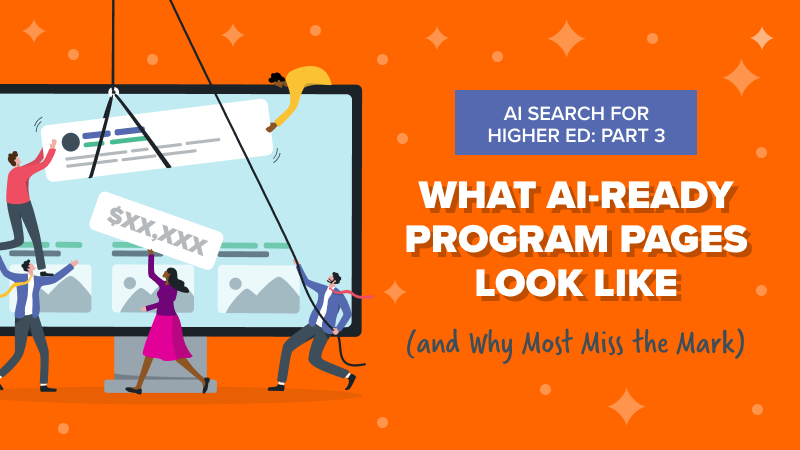
What AI-Ready Program Pages Look Like (and Why Most Miss the Mark)
AI Search for Higher Ed: Part 3
AEO Series

by Keith Warburg, Digital Strategist
In an AI-driven search environment, program pages are no longer just marketing assets. They are decision engines. AI systems increasingly rely on them to answer questions about eligibility, cost, outcomes, and pathways.
Most higher ed program pages miss the mark because they prioritize promotional language over clarity, bury critical information, and fail to present a coherent “source of truth.”
AI-ready program pages are structured, answer-first, decision-supportive, and grounded in institutional credibility. When designed intentionally, they serve both prospective students and the AI systems guiding discovery.
The Program Page Problem in Higher Education
Most program pages were not designed for today’s search environment. They evolved over time, layered with marketing copy, faculty preferences, SEO compromises, and CMS constraints. The result is often a page that looks comprehensive but struggles to answer the most basic questions quickly.
From an AI perspective, these pages are hard to summarize. From a student perspective, they’re hard to use.
This creates a quiet but costly gap: Your institution may have excellent programs, but the way they are presented makes them difficult for AI systems to confidently explain and for students to confidently choose.
In AI-driven search, program pages function as primary reference documents. When a prospective student asks these questions, AI systems often look to program pages first:
- “What are the admissions requirements for a BSN program?”
- “Is this master’s program online or in person?”
- “What can I do with this degree?”
If the answers are unclear, inconsistent, or buried, the system may turn to third-party summaries or competitor institutions instead.
In other words, your program page may be shaping perception even when it isn’t earning traffic. That makes program pages one of the most important and under-optimized assets in higher education marketing today.
The Difference Between Marketing Content and Decision-Support Content
One of the biggest shifts required for AI readiness is moving from pure marketing language to decision-support content. Marketing content focuses on persuasion. Decision-support content focuses on clarity.
AI search systems and prospective students need both. But they need them in the right order. Pages that lead with vague claims like “innovative curriculum” or “hands-on learning” delay understanding. Pages that lead with concrete answers establish trust and momentum.
This is where the concept of answer-first structure becomes essential.
What “Answer-First” Actually Means
An answer-first program page does not mean oversimplifying your program or stripping away nuance. It means acknowledging a simple truth: users arrive with questions, not patience.
An effective answer-first section typically appears near the top of the page and includes:
- A concise program summary explaining who the program is for, what credential it offers, how it’s delivered, and where it leads
- A short set of at-a-glance facts that ground the reader in reality before they scroll
This approach benefits AI systems because it surfaces the most important information early and clearly. It benefits students because it reduces cognitive load. Everything else on the page should expand on, not compete with, that foundation.
Why Commodity Content Fails in AI Search
Many institutions unknowingly publish commodity content: pages that could belong to almost any university offering a similar program.
In an AI environment, this content blends into the background. When multiple pages say the same thing in slightly different ways, AI systems look for signals that differentiate authority and usefulness.
Non-commodity program content often includes:
- Program-specific outcomes or pathways
- Unique facilities, partnerships, or clinical experiences
- Accreditation nuances or licensure alignment explained plainly
- Modality or cohort details that affect student fit
- Clear explanations of prerequisites and progression
This is not about adding more content. It’s about adding the right content, expressed clearly.
Commodity content refers to a program page or marketing copy that is interchangeable with what nearly every peer institution publishes.
It relies on broad, nonspecific claims (e.g., “innovative curriculum,” “hands-on learning,” “prepares students for success”) without clearly explaining what is actually different, measurable, or unique about the program.
For AI search systems and prospective students, commodity content provides little signal about authority or value. When multiple institutions say the same thing in similar ways, AI systems have no clear reason to cite one over another.
Designing Program Pages for Question-Driven Journeys
AI search reinforces what usability testing has shown for years: Prospective students navigate in questions, not sections.
Strong program pages anticipate and answer those questions in a logical sequence:
- Can I apply?
- What does it cost?
- How long will it take?
- What will I be qualified to do afterward?
- What are my next steps?
Pages that force users to hunt for these answers or click across multiple disconnected pages introduce friction that AI systems are designed to remove. Structuring program pages around real questions does not make them simplistic. It makes them usable.
Trust Signals Belong in the Body, Not the Footer
Universities often rely on implied authority. In AI search, implication is not enough. AI systems look for visible, attributable trust signals:
- Accreditation statements with dates
- Faculty credentials tied to the program
- Outcomes presented with context
- Links to catalogs, licensure boards, or official policies
These signals should live near the content they support, not buried in footers or separate pages. For students, this builds confidence. For AI systems, it reinforces that the information is reliable and current.
Program Pages as AI Landing Pages
A helpful way to reframe program pages is to treat them as AI landing pages. They are not just destinations for clicks. They are sources from which answers are drawn.
AI-ready program pages tend to share a common structure:
- A clear, answer-first summary
- Concrete program facts presented consistently
- Logical sections that map to real student questions
- Credibility woven throughout, not bolted on
- Clear next steps that guide action
This structure supports discoverability, comprehension, and conversion without sacrificing institutional voice or brand.
Why Most Institutions Miss This (and Why That’s Understandable)
Higher education teams rarely design program pages in isolation. Content decisions are influenced by:
- CMS limitations
- Governance and approvals
- Internal politics
- Legacy structures
- Competing stakeholder needs
The result is often compromise, not strategy. AI search changes the cost of that compromise. What was once merely suboptimal is now potentially invisible.
The good news is that improving program pages does not require rebuilding the site from scratch. It requires intentional prioritization and a shared understanding of how modern search works.
What Comes Next
Once program content is structured clearly and written for decision-making, the next layer is technical clarity.
In the final post in this series, we’ll explore:
- How structured data supports AI understanding
- Why accessibility and governance are AI readiness issues
- How to measure success when clicks are no longer the whole story

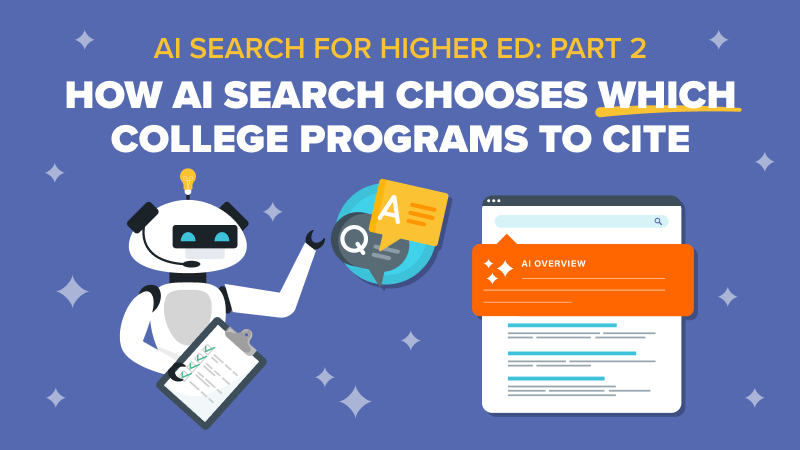
How AI Search Chooses Which College Programs to Cite
AI Search for Higher Ed: Part 2
AEO Series
by Keith Warburg, Digital Strategist
AI-powered search experiences don’t “rank” pages the way traditional search does. Instead, they synthesize answers and selectively cite sources that are clear, trustworthy, and easy to attribute.
For higher education institutions, success in AI search often means becoming the canonical source for specific facts and questions, not simply earning a click. Program pages that are well structured, unambiguous, and grounded in institutional authority are far more likely to be surfaced, summarized, and cited.
From Ranking Pages to Synthesizing Answers
Traditional SEO trained us to think in terms of rankings, impressions, and click-through rates. AI-driven search changes that mental model.
In AI-powered experiences like Google’s AI Overviews or Microsoft Copilot Search, the system’s primary goal is not to send traffic, but to answer the user’s question. To do that, it evaluates multiple sources, extracts relevant information, and assembles a synthesized response.
Google has explained that its AI features are designed to help users quickly understand a topic and continue exploring, using web content as the underlying source of truth.
This means your content may influence a user’s decision even if the user never clicks your page. For higher ed teams, that’s a shift worth taking seriously.
What AI Search Is Actually Looking For
AI search systems do not think in keywords. They think in questions, facts, and relationships. When deciding which sources to cite, these systems tend to favor content that:
- Clearly answers a specific question
- Presents information in a way that can be confidently attributed
- Aligns with other trusted sources without contradiction
- Reduces ambiguity rather than adding interpretation
This is why vague marketing language struggles in AI search environments. Statements like “robust curriculum” or “hands-on learning” may appeal to human readers, but they don’t translate cleanly into verifiable answers.
By contrast, clear, specific information (credit requirements, modality, licensure alignment, application deadlines) is much easier for AI systems to extract and reuse.
What “Winning” Looks Like in AI Search
In AI search, success often looks quieter than a top ranking — but it can be more influential. “Winning” might mean:
- Your nursing program page is cited when a user asks about licensure requirements
- Your tuition page becomes the reference point for cost-related questions
- Your admissions requirements are used to answer eligibility questions across multiple follow-ups
In these cases, your institution is shaping the conversation even before a user reaches your website. This is especially important in higher education, where early understanding influences whether a student applies, self-selects out, or pursues a competing institution.
Why Structure Matters More Than Ever
One of the most underappreciated requirements of AI search visibility is extractability. AI systems need to be able to:
- Identify what a page is about
- Locate the most relevant information quickly
- Determine whether that information is authoritative and current
Pages that bury critical details deep in long narratives or scatter answers across multiple sections create friction. Pages that lead with clear summaries, descriptive headings, and well-organized sections make it easier for AI systems to do their job.
Google has emphasized that as queries become longer and more complex, content that is uniquely helpful and well structured is more likely to succeed.
For program pages, this often means adopting an answer-first mindset: providing a concise, accurate summary before diving into supporting detail.
Canonical Facts vs. Narrative Content
Not all content plays the same role in AI search. AI systems tend to rely heavily on what we might call canonical facts: information that should have one clear, authoritative answer. For example:
- Degree type
- Credit hours
- Delivery format
- Tuition ranges
- Admissions requirements
- Licensure alignment
When these facts are inconsistent across pages, AI systems face a trust problem. In some cases, they may rely on third-party sources instead of the institution itself. Narrative content still matters, but it works best when it supports, explains, or contextualizes those core facts rather than obscuring them.
For higher ed teams, this reinforces the importance of treating program pages as systems of record, not just storytelling surfaces.
Why Ambiguity Is the Silent Killer
AI search systems are designed to reduce uncertainty for users. That makes ambiguity one of the biggest threats to visibility. Common higher ed issues that introduce ambiguity include:
- Conflicting tuition figures across pages
- Different names for the same program or concentration (or duplicate pages)
- Admissions requirements that vary depending on where a user looks
- Outdated deadlines or prerequisites that remain indexed
In traditional search, users might navigate around these inconsistencies. In AI search, the system often makes a judgment call on the user’s behalf, and that judgment may exclude your content entirely.
Clarity, consistency, and freshness are no longer just best practices. They are prerequisites for participation.
What This Means for Higher Education Marketing Teams
AI search doesn’t require universities to invent authority — they already have it. What it requires is intentional expression of that authority.
Teams that succeed in AI search tend to:
- Clarify the questions their audiences are actually asking
- Present answers in a way that is easy to extract and verify
- Reduce internal inconsistencies across web properties
- Align content structure with how modern search systems operate
This is less about optimization tricks and more about operational discipline.
What Comes Next
Understanding how AI search selects and cites sources sets the stage for the real work: content.
In the next post in this series, we’ll explore what AI-ready program pages actually look like, why most institutions still rely on commodity content, and how to design pages that support real student decisions, not just rankings.
Ready to Evaluate Your Site for AI Search?
If your institution hasn’t yet evaluated how its program pages, admissions content, and core facts appear in AI-driven search, now is the right time.
Spark451 offers AI-readiness site audits for higher education institutions, designed to identify:
- Gaps in clarity and structure
- Inconsistencies that undermine trust
- Missed opportunities to become a cited source in AI search
- Practical, prioritized recommendations your team can act on
Contact us to start an AI-readiness site audit and understand how your content performs in the search experiences shaping the next generation of student discovery.
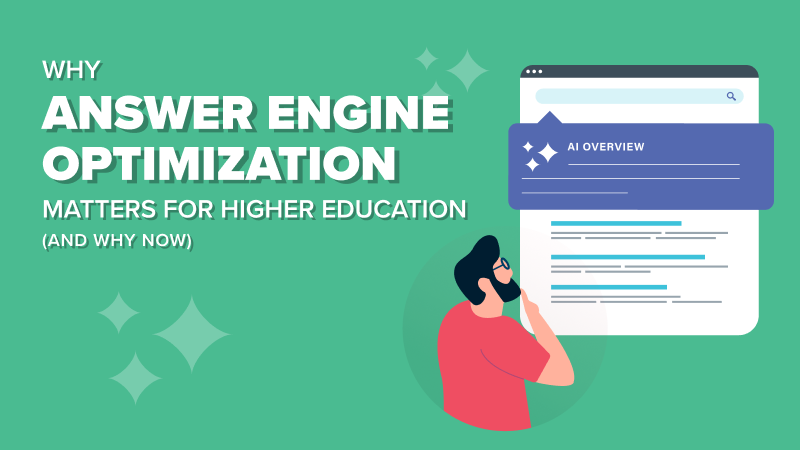
Why Answer Engine Optimization Matters for Higher Education (and Why Now)
AI Search for Higher Ed: Part 1
AEO Series
by Keith Warburg, Digital Strategist
Search is changing. Not all at once, and not in a way that makes traditional SEO obsolete. But it is changing in ways that higher education marketing teams can’t afford to ignore.
Across Google and Microsoft, search experiences are increasingly “answer-first.” Instead of presenting a list of links and letting users do the work, modern search interfaces summarize information, suggest follow-up questions, and guide users through conversational journeys. In many cases, users encounter answers before they ever decide whether to click.
This shift is subtle, but its implications for colleges and universities are significant. It reshapes how information is discovered, how trust is established, and how institutions show up (or don’t) in moments of high intent.
That’s where Answer Engine Optimization (AEO) comes in.
How Prospective Student Search Behaviors Are Changing
For enrollment management professionals, the most important change isn’t the technology itself, but how prospective students are now framing their questions.
Students are no longer just typing short, category-based queries like “MBA programs in Florida” and clicking through lists of links. Increasingly, they’re asking AI engines long, narrative questions that combine personal context, constraints, and goals in a single prompt.
Those questions often sound more like conversations than searches:
- “I’m a working professional with a business background, two kids, and limited time. I want an MBA that’s flexible, affordable, and respected by employers.”
- “I’m interested in healthcare, but I don’t know whether nursing or public health is a better fit given my GPA and career goals.”
- “I want a program that leads to licensure, but I may need to start online and transfer later.”
In these moments, the AI system is not returning a ranked list of schools. It is interpreting the student’s situation and synthesizing guidance based on what it understands about programs, pathways, outcomes, and institutional fit.
That has real enrollment implications.
AI search increasingly acts as an early-stage advisor, shaping awareness and consideration before a student ever reaches an institution’s website, fills out a form, or speaks to an admissions counselor. If your program content cannot clearly answer questions about fit, flexibility, outcomes, and requirements, the system may simply exclude it from the conversation or summarize it inaccurately.
For enrollment teams, this means visibility is no longer just about being found. It’s about being understood in context. Institutions that clearly articulate who a program is for, how it fits into real lives, and what it leads to are far more likely to surface in these AI-mediated discovery moments.
Answer Engine Optimization, in this sense, is not a technical exercise. It’s an enrollment strategy.
What Is Answer Engine Optimization?
AEO is the practice of structuring and presenting content so that AI-driven search systems can easily extract, understand, and cite it as a reliable answer.
AEO is not a replacement for SEO. It is an evolution of it. Where traditional SEO focused on keywords and rankings, AEO emphasizes:
- Clear, answer-first content
- Strong topical structure
- Consistent, trustworthy facts
- Signals that establish authority and credibility
The goal is not to “optimize for AI” in a gimmicky way. The goal is to make your content unambiguously useful for the systems that increasingly mediate how people find information.
Google has framed success in AI search around content that satisfies user needs, especially as queries become longer and more specific. That guidance aligns closely with what higher education audiences already expect from institutional websites.
From Rankings to Answers
For years, SEO success was primarily about visibility in ranked results. While rankings still matter, AI-driven search introduces a new layer: being used as a source.
In answer-first experiences like Google’s AI Overviews, search systems synthesize information across multiple websites to respond directly to user questions. When sources are cited, those citations tend to come from pages that are clear, structured, and confidently attributable.
In other words, it’s no longer just about whether your page ranks. It’s about whether your content is good enough to be trusted as the answer.
Google has been clear that its AI features are built on the same core principles as Search: content must be helpful, reliable, and designed for people first. What’s changed is how aggressively those qualities are tested. AI systems are far less tolerant of ambiguity, inconsistency, or buried information.
Why Higher Education Is Uniquely Exposed
Not every industry feels this shift equally. Higher education sits in a category where accuracy, clarity, and trust are not just best practices, they are also expectations. As a result, institutions face a unique combination of risks and opportunities.
- Program pages function like product pages. These are high-intent destinations where prospective students make high-stakes decisions involving time, money, eligibility, and long-term outcomes. Prospective students rely on them to answer questions about admissions requirements, tuition, modality, licensure, and career pathways. When AI systems summarize information about a program, they are effectively shaping perception before a user ever reaches your site.
- The cost of misinformation is higher. Tuition figures, prerequisites, deadlines, licensure requirements, and modality details are not abstract marketing claims. They are operational facts. When AI systems summarize or reference that information, the margin for error shrinks. Outdated tuition figures, conflicting prerequisites, or vague descriptions don’t just frustrate users, they introduce real risk.
- Higher education content is inherently complex. Degree pathways, transfer rules, accreditation nuances, and outcomes data do not lend themselves to vague language. AI systems favor clarity, specificity, and confidently attributable sources, which are qualities that institutions must intentionally design for.
- At the same time, higher education institutions often have a natural authority advantage. Universities are primary sources for their own programs. The challenge is not credibility in theory, but credibility in execution. Information must be easy to understand, verify, and extract.
Google has emphasized that AI search still depends on content that can be crawled, understood, and trusted. Institutions that treat their websites as authoritative systems of record (not just marketing surfaces) are better positioned as search evolves.
What Stays True (and What Doesn’t)
Despite the headlines, AI search has not invalidated the fundamentals of good web strategy. AI-driven systems still rely on:
- Indexable, accessible content
- Clear information architecture
- Pages that demonstrate expertise and trustworthiness
- Content that satisfies real user needs
AI systems do not invent authoritative information about your programs. They rely on what already exists on the open web. If your content is unclear, inconsistent, or fragmented across pages, AI search doesn’t fix that problem — it amplifies it.
What has changed is how unforgiving the system has become. In traditional search, a user might click multiple results to compare information. In AI search, the system does the comparison on the user’s behalf. That means gaps, inconsistencies, or unclear answers are more likely to disqualify a page entirely, especially when better-structured alternatives exist.
This doesn’t mean dumbing content down. It means respecting how modern systems and modern users process information, and answering real questions directly and confidently.
The Strategic Opportunity for Higher Ed Teams
While AI search introduces new complexity, it also presents a meaningful opportunity for higher education institutions.
Universities already possess what AI systems are looking for:
- Subject matter expertise
- Firsthand institutional knowledge
- Authoritative primary sources
- Credible outcomes and accreditation data
The challenge is not authority, it’s expression. Institutions that invest in clearer structure, more direct answers, and stronger trust signals can shape how their programs are represented in AI-driven search experiences. Those that do not make these changes risk having their information summarized by third-party sources with less context and nuance.
What Comes Next
Answer Engine Optimization is not a single tactic. It’s a mindset shift that affects content strategy, page structure, technical foundations, and governance.
In the next post in this series, we’ll provide a jargon-free breakdown of how AI search actually selects and uses sources, what “winning” looks like when clicks are less predictable, and why structure and clarity are strategic advantages for higher education teams.
Ready to Evaluate Your Site for AI Search?
If your institution hasn’t yet evaluated how its program pages, admissions content, and core facts appear in AI-driven search, now is the right time.
Spark451 offers AI-readiness site audits for higher education institutions, designed to identify:
- Gaps in clarity and structure
- Inconsistencies that undermine trust
- Missed opportunities to become a cited source in AI search
- Practical, prioritized recommendations your team can act on
Contact us to start an AI-readiness site audit and understand how your content performs in the search experiences shaping the next generation of student discovery.